Aeon Igni

It's just you and the universe.

  • About Aeon Igni

Salvation Quote #1

Posted by Aeon Igni on April 29, 2015
Posted in: Quotes, Salvation, Science Fiction Writing, Writing. Tagged: characters, quote, salvation. Leave a comment

Very early in becoming an author, you realize that writing is an art. Creating a finished piece does not simply require putting pen to paper – it takes hours of painstaking work to write, revise, revise again, and then revise some more, and often you still aren’t entirely happy with the finished product.

I find that writing lines from the characters’ voices can be especially hard in science fiction. Taking in unique, unearthly situations and using your characters’ perceptions, perspectives, logic and speech to describe and react to those situations is what makes the fictional world truly real.

I have selected a some quotes from Salvation to share over the next few weeks, and hopefully you will get a sense of the characters and the story behind them as each new quote is added to the mix.

salvation_quote2

Dark Romance Inspiration Song #2: Beautiful by Pop Evil

Posted by Aeon Igni on April 24, 2015
Posted in: inspiration, Romance, Science Fiction Writing, songs. Tagged: romance, science fiction writing, songs, writing inspiration. Leave a comment

you’re beautiful – you’re beautiful to me
don’t ever say you never lost your way
you’re beautiful today
and every day for the rest of your life

Last week, I mentioned that I often use music to get myself ‘into the mood’ for writing. One of the songs I used for my soon-to-be-released steampunk series is Beautiful, by Pop Evil.

This song is special to me because it communicates strongly and clearly that beauty is in the eye of the beholder, and that each of us is beautiful to someone. It really fit the series, because my hero, Cyrus, has bionic legs and a bionic eye from being involved in a mine explosion, and my heroine has been through her own battles working underground in a mine for five years. Neither of them feel beautiful, but each of them is beautiful to the other, and eventually comes to see that beauty in themselves.

Creating this type of feeling before writing is very important to me, because I want my characters to be beautiful despite their flaws, or perhaps because of their flaws. . I can only hope that my characters inspire the feelings of love and self-acceptance in the reader that this song inspired in me when I was writing.

And this idea doesn’t have to be relegated to the realm of fiction. I think it is important to remember that YOU are beautiful, flaws and all. In fact, your flaws are probably your greatest undiscovered assets. They make you unique, they give you obstacles, and they imbue you with character.

for the rest of your life
for the rest of your days
you feel it inside in every way
for the rest of your life

 “Beautiful”
Written by Leigh Kakaty, Davey Grahs, Johnny K & Shaun Michael Lichtenstein
Performed by Pop Evil on the Album Onyx

Dark Romance Inspiration Song #1: Angel by Theory of a Deadman

Posted by Aeon Igni on April 17, 2015
Posted in: inspiration, Personal, Romance, songs. Tagged: personal, science fiction writing, songs, writing inspiration. Leave a comment

i’m in love with an angel
heaven forbid
made me a believer
with the touch of her skin

I often use music as a catalyst when I’m writing. The combination of lyrics and melody can instantly evoke powerful emotions and imagery in the listener…and since as an author I am trying to do the same in the mind of the reader, it helps me to get into that state of mind when I’m writing.

There are many songs which I consider to be almost akin to the musical version of romance novels. However, often people think of typically ‘pop’ songs in this category. I tend to like darker music, and heard this dark ballad, Angel, for the first time today on the local hard rock station.

I was instantly swept away by its power and beauty. To me, the lyrics read as a wonderful prologue to a dark, paranormal romance, where the man comes to the realization that he has to let go of the love of his life.

Perhaps not surprisingly, the video uses strong, romantic imagery typically seen on the covers of romance novels, a beautiful woman in a white gown walking through the forest, often superimposed with the image of the singer. She heals a white dove by whispering into its ear, and then succumbs to death herself.

Of course, as a science fiction romance author I believe that the song is begging for someone to pick up the story and detail what happens next. Does she rise from the dead? Does he arrive and bring her back with a kiss? Do they meet again, years later, in another life? The beauty of art is that it’s all up to your imagination.

you wanted a soldier, but it wasn’t me
because i could never set you free
so fly on your own
it’s time i let you go

Written by Herr Jager
Sung by Theory of a Deadman
https://www.youtube.com/watch?v=thfpVOAC-y0

How Sci-Fi writing is similar to a PhD

Posted by Aeon Igni on January 22, 2015
Posted in: Uncategorized. 1 Comment

As I was doing some research on my phd this week, I had an epiphany. I finally understood why – although doing a phd and writing science fiction seem so far apart – they are both just as exciting and actually complement each other quite well in my mind.

And the answer is: Critical Realism. Well, to many of you that would be like me saying that the answer to life is 42 – so let me give part of an explanation (because the full entirety of it would probably be a thesis in its own right).

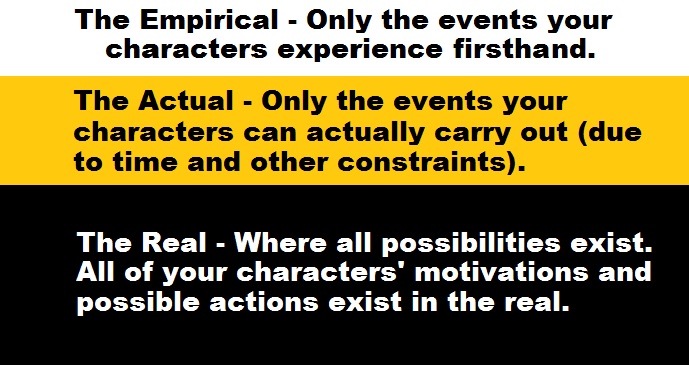
Critical realism – the main philosophy which underpins my work – breaks the world into three strata: the real, the actual, and the empirical. The real is all of the possibilities which could exist, the actual is the events which actually happen, and the empirical is the events which we actually experience.

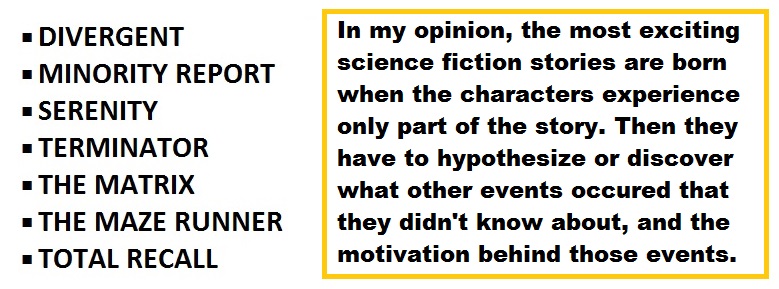
And, if you write science fiction (or perhaps in any genre), this is really nothing new to you! As an author, you create a world where all possibilities exist. Then, you have events which actually happen, some of which your characters experience firsthand, and some of which they don’t.

CR blog 3

Then your characters have to deal with the outcomes of those events, and perhaps try to figure out why they happened in the first place so they can fix those problems or at least avoid them in the future.

CR blog 3b

As an author, you are continually positing the consequences of what will happen if certain mechanisms trigger certain events, and what will happen if other mechanisms trigger opposite events.

In my phd, I am doing the same thing, trying to figure out the mechanisms which are causing a crisis in higher education in Korea. It might seem very far removed, but it really isn’t. The questions:

Why are the main characters trying to overthrow the government in my steampunk novel?

and

Why are the graduates not getting jobs in the current industrial environment in Korea?

both have their roots in sociopolitical economy. And if I didn’t want to ask questions about society, government, economy, and most of all, people, I wouldn’t be able to do either task very well.

Above all, to do either the fiction writing or the thesis well, the most important two things are to do the research, and then continually ask,  “Why?” Why does my character do this? Why do my characters interact like this? Why does society behave this way?

And if we want to talk about word counts, by the time I’m done with my steampunk series I will have written far more than the 100,000 words required for my thesis.

So now that you know being a writer is pretty similar to getting a phd – just without the frazzled look and the dingy back-corner office – grab a cup of coffee and get cracking!

Steampunk Worldbuilding III – Money, Money, Money

Posted by Aeon Igni on January 18, 2015
Posted in: Science Fiction Writing, Writing. Tagged: author resource, science fiction writing, steampunk, worldbuilding, writing. Leave a comment

moneyblog

This is the third post in a series about Steampunk Worldbuilding.

If you’re a science fiction fan, you probably know that Luke only sold his speeder for 1600 credits, and Han wanted 8,000; so Luke and Ben compromised, paying 2,000 in advance with 15,000 agreed upon arrival in Alderan.

Han also had a price on his head “so large, every bounty hunter in the galaxy will be looking for you” – according to Greedo, that is. But that price was almost motivation enough for him to desert his friends and future wife to pay Jabba off. Good thing Leia takes care of that for him later!

I knew that my Steampunk world needed to include money in a big way. Why? Well for one thing, my hero, Cyrus, is a pirate. Why do people become pirates? They are societal outcasts for some reason and are forced to steal to survive. I also have a dominant form of government, the New Alliance, and a rebellion. My world has rich people, poor people, and everyone in between – and money is both a motivating factor and an explanatory factor for the things that they do.

When asking questions such as:

• Why is Cyrus a pirate? Is he a successful pirate – and what does that mean?
• Why is Evangeline a slave?
• Why is the New Alliance so powerful?
• Why isn’t the rebellion in power?
• Why would people spy for either side?
• Why wouldn’t the common people stand up to the government?

I always came back to one answer: money. Or technology – which lead me back to money. But asking the questions above were extremely powerful because they allowed me to build the back story for each of the characters, and to discern how important money was as a primary motivation for each of them.

To build my world, I used a lot of the concepts in the book, Grain Into Gold. I came up with the idea that there would be multiple currencies still floating around from before the First War, because it does take time to mint new currencies and the United States is still across the pond, so it would be the last to receive that currency and have its use enforced. Even if the New Alliance minted a new currency, there would still probably be private exchanges in other currencies for those who have access to international travel.

Interestingly, my father was a career history teacher and he explained that one of the problems with the U.S. when it first began was that every state was minting its own currency. This practice pretty much halted trade between the states until the federal government stepped in and forced everyone to use one currency. But it begs the question of what happened to each of the former state currencies. Were they traded in one-to-one for the new federal currency? Or did some states’ currencies count more than others?

Anyway, those questions are just for the trade of an expired single currency for a new currency. The nice thing about having multiple currencies is that you can ask questions like:

• What are the exchange rates between currencies – and how easy is it to exchange them? (I mean, a galleon may be worth $10.07 USD, but really, who is going to exchange it except Gringott’s – and what if you can’t go in there?)
• If someone was rich before the new government, would they still be rich after the takeover if a new currency takes effect?
• What happens when a currency becomes worthless?
• Would the New Alliance and the rebellion be using the same currencies? Or would one be worth more than the other?
• How could the either the rebellion or the New Alliance use currencies to their advantage in a war?

The use of currency allowed me to build a more realistic world, with characters whose motivations we understand because they still mirror our reality even though the world itself is very different.

The use of multiple currencies can give some amazing potential for economic warfare. What if one state’s currency suddenly becomes worthless? What if all currencies become worthless to the New Alliance but its own – and the ruler decrees the death penalty for everyone who can’t pay taxes that year?

I hope that this has given you some food for thought. In the fourth post, I will discuss mining in the 1850s, and how I used the mines and mine lords to give depth and realism to my world.

Why do you read romance novels?

Posted by Aeon Igni on January 16, 2015
Posted in: Personal. Tagged: personal, reading, true love. Leave a comment

loveblogfinal

I spent the past week reading romance novels. Why? Well, I had a severe flu that just wouldn’t quit, and my husband has been out-of-town for work.

But last night as I was searching through my kindle library for a specific romance novel, I realized that all week I had been subconsciously reading and rereading romance novels this week for one reason: I wanted to absorb the feeling of being truly loved.

Not all romance novels do that – and I’m not just talking about Naughty Nooners. Many romance novels are very good at expressing the physical desire, rampaging emotions, and tug-of-war that occurs within all of us as we overcome internal and external obstacles and fall in love. I think that most novellas I read are like this; they do a great job of giving a snapshot of a romance.

But this week, I wasn’t looking for insta-love or fated mates or a hot alpha taking one look at the heroine before throwing her over his shoulder and taking her back to his lair.

I was  looking for more. I was looking for the romance novel where the hero or heroine had loved the other for some time – maybe even years. Where he would move heaven and earth to make her life complete. I was looking for the books that made me feel as good as Pride and Prejudice with Matthew Macfadyen and Kiera Knightly. A tall order.

And in looking for those books, I realized how relatively rare they are, at least for me. In the end, what I read is an interesting cross-section of different genres with one thing in common: they all give me the amazing feeling of being truly loved by someone who desires more than the body, more than the moment…someone who desires the other person till death do them part and then some.

So, after all that, what did I read?

  • Ashes in the Wind by Kathleen Woodiwiss – historical romance novel
  • The Man Within by Lora Leigh – breeds romance novel
  • Predatory Game by Christine Feehan – science fiction romance novel
  • Wishful Thinking by Evangeline Anderson – paranormal romance novel
  • Luring Lucy by Lori Foster – contemporary romance novella
  • Second Hope Cowboy by Rhonda Lee Carver – western romance novel
  • Private Practice by Samanthe Beck – contemporary romance novel
  • Splintered Mirror by Morgan Hawke – fantasy erotica

Okay, so maybe the warm and fuzzy true love is a stretch with that last one. But Morgan had me on the hook with the female that had dressed as a boy valet for the prince for years – and the tension between them fairly crackled off the page.

What I love about making lists like this is realizing the diversity of stories that can create the same effect in the reader; and even better, I know every single reader will have a different list of books that create the same feeling within them.

Anyway, I am finally starting to feel somewhat better – an outcome directly attributable to my heavy reading schedule, I’m sure. Next week, I’ll probably be back to reading my standard fare of sci-fi romance novels for a different reason – for now I’ll just call it improving my imagination and ability to visualize.

But that brings me to you – why are you reading romance novels these days?

Creating The Right Answer – For You

Posted by Aeon Igni on January 11, 2015
Posted in: Personal, Writing. Tagged: authors, personal. 2 Comments

2015 banner

Tara Rane has written another powerful blog which provokes several thoughts of my own, entitled: “There is always more than one right answer.” In her blog, she discusses how she solves her problems in a way that is right for her.

For Authors

The blog post reminded me of a saying I heard at an author class, something to the effect of “There are no new stories, only new voices to tell them.” The speaker made the point that, especially in the romance genre, the story of a man and a woman falling in love has already been told a million times.

It doesn’t matter if he’s an aristocrat, highlander, pirate, cowboy, firefighter, navy SEAL, rock star, vampire, werewolf, or alien; or whether she’s feisty, funny, intelligent, strong, sarcastic, naive, vapid, a pushover, or any combination thereof; every pairing possible has probably already been done. Many times.

The only new thing about your story will be your perspective, your voice, and how you tell the tale. And that means that there is  always more than one right answer. There are literally unlimited right answers, as long as they are told in a way that will bring them to life in the minds of the readers.

For Life

But in honor of the New Year, where I really want to go with this post is the idea that there is always more than one right answer in anything you do. As with your writing, the only answer that is ‘right’ is the one that is right for you.

After ten years of traveling, living in five countries and visiting many, many more; I have found that people all over the world live lives that are completely different from each other. People from other cultures, or even from within their own culture, might try to judge them – but each of them is living the life that is right for him or her.

For myself, I returned home to find people who remained here and built their careers and families in Phoenix. While they may tell me they envy my adventures, I can tell them I envy their stability.

The point is that each path was ‘right’ for the person who was living it. Each path required a multitude of decision points along the way, and only we as individuals could make them…to choose the path that was right for us at the time.

There are advantages and disadvantages to every choice we make. The only thing that makes a choice correct is how we feel about it. Even the eventual outcome isn’t as important as the journey at hand…and measuring your life by outcome probably isn’t a very good strategic tactic, anyway. It just takes too damn long.

So, when you get the urge to compare yourself to all of your friends, or make resolutions which will make you richer, thinner, better dressed, or any other adjective of measurement that is set by someone else’s standard, just remember that there are a million ‘right’ answers – actually, there are over six billion ‘right’ answers living their own lives on this planet right now.

And you are already one of those right answers. Whatever you choose to do with 2015, I wish you all the best on continuing to create the path that is right for you.

Steampunk Worldbuilding II – Building Society and Social Problems

Posted by Aeon Igni on January 9, 2015
Posted in: Science Fiction Writing. Tagged: author resource, science fiction writing, steampunk, worldbuilding. Leave a comment

steampunk1

As I mentioned in my last post, I created a world where Nicholas I of Russia took over the northern hemisphere, calling his new empire the ‘New Alliance.’ After creating the time, place, and governmental structure of the world, I needed to think about the impacts of these things on the society.

I wanted my characters to have a kind of innocent heroism that comes from not seeing war. I had never really pondered this before writing this series, but Luke Skywalker, Harry Potter, Neo, Katniss Everdeen, and many, many other heroes are all born in the time period after a war, where the adults are still suffering the after effects of the first war, but they go forward despite the warnings.

So I decided that when Nicholas I actually conquered the people it would be called the First War, and it would have happened around 1830, about 20 years prior to the start of my story. Cyrus and Evangeline would have been too young to participate in the First War but they would have felt its effects, and they interact with people like Dr. Riggs and Captain Madrid who had been in the rebellion during the first war.

To create the societal tensions in your story, you want to ask questions about what happened to the people before, during, and after recent major events. For me, these were questions about what happened to the people before, during and after the most recent war occurred.

These questions can be as large or small as you want them to be. For example, you could ask broad, sweeping questions such as:

1. How does a hostile takeover affect the people of a country?
2. Does it differentially affect the rich and the poor?
3. How does it affect minorities such as women or people of color?
4. What is the new money system based on?
5. Who ‘buys in’ to the new government and why? Who doesn’t and why not?

Or you could ask more specific questions tailored to your world, as I did:

1. How did Nicholas I taking over the world affect the people?
2. How did the rich people react when he swept into North America? What about the poor?
3. What happened to women’s rights since he was from conservative Eastern Europe and the United States was one of the most liberal countries for women’s liberation?
4. Who did the New Alliance make rich in their new world and why?
5. What happened to people who were members of the former rebellion? Did he kill them? Torture them? Did some escape?

These answers will then be woven into your story, providing the motivations and underlying hopes and fears of both protagonists and antagonists.

My answers to these questions are woven through the six novellas, and as they progress the characters become a lot more detailed because they have this history. There are people who were rich before the war who went along with the New Alliance despite their hatred for it, rich people who are now poor because they had joined the rebellion, and plenty of poorer people who go along with the New Alliance because the form government didn’t really affect them as long as they get paid for their wares. There are the new rich mine lords, endorsed by the New Alliance because they use slavery to make millions, and the pirates who steal from them to give to the poor. Women who had been free are now slaves to the whims of men again.

These answers also gave me running themes – class struggles, the struggle for individual freedom, women’s independence, and the struggle for individual identity and meaning. What will my characters sacrifice for their ideals? Will they lie for them? Fight for them? Die for them?

Around the time I was answering these questions, I did do some research on the United States at the time the story was supposed to take place. In actual United States history, the 1850s saw women’s rights and human rights as huge issues. The 1850s saw the first coed university, women were being granted the right to own property in their own name in several states, and the right to have separate economy from their husbands. The Civil War was fought from 1861-1865, killing over 600,000 people. The end of the Civil War saw the collapse of the south, the end of slavery, and the expansion of civil rights.

The real history at the time was rich and vibrant, and variations of the themes provided enough inspiration to make a vivid, detailed steampunk world.

Steampunk Worldbuilding I – Building the government and history of an epic world

Posted by Aeon Igni on December 21, 2014
Posted in: Science Fiction Writing. Tagged: author resource, science fiction writing, worldbuilding. 1 Comment

Steampunk I

This post is the second in a series about Steampunk Worldbuilding. In this blog post I will tell you some of the themes of steampunk, as well as a bit of how I created my own world.

The first thing I did when my magazine submission was rejected (so I got serious about writing steampunk – damn you, competitive nature!) is research. I went to Barnes and Noble, because I was too impatient to wait for Amazon delivery, and bought Steampunk: An Illustrated History by Robb and The Steampunk User’s Manual by Vandermeer and Boskovich.

Those two encyclopedias went through the history of steampunk and the main themes: rebellion against a tyrannical government, individual freedom, and the equality of women being a few. There are also the sci-fi themes of new technology, discovery of new worlds or new frontiers, and encountering strange and/or dangerous unknown phenomena.

After reading, I began to think about the setting. I wanted a time and place in history that would have been interesting to write about, where many of these themes would have come up naturally. Most steampunk work is set in England, which is fair, since a lot of it the clothing and setting is derived from Victorian culture. But I wanted to provide a unique perspective on steampunk, and give my characters room to grow in a different setting, so I set the work in the United States.

I wanted the world to be a lot smaller than it is today – with a populated eastern seaboard but the west as a yet unknown frontier. A wild land that had yet to be fully explored would give me the opportunity for exploration, new technologies, and a lot of places for the rebellion to hide from a New Alliance. The mid-1800s fit the bill nicely in that respect – now I needed to build my government.

When you are going to create a world, probably the most important thing you need to know is:

1. Who rules it?

Why do you need to know this? Well, the end of pretty much every epic story is the overthrow of the ruler, so you’re going to be building up to it over your series. It doesn’t matter if it’s the Emperor, Voldemort, the machines, or the Capitol, you need to know who the supreme ruler is. You don’t need to tell the reader all of the specifics, but as the author, you need to know them so you can give depth and breadth to your plot.

Going further, you need to ask questions about the supreme power and its motive.

2. Why is the supreme ruler in power?
3. How did it come to power? – Bloody battle between two powers? Multi-faction war? Economic overthrow? Superior technology? Did the opponents fight, or simply give up?
4. How does it keep power? – Fear? Economic means? Technological means?
5. Who are its allies?
6. Who are its enemies, and how much power do they have?

To create my supreme ruler, I began poking around the 1850s, and for some reason Russia came to mind. Growing up during the Cold War between the U.S. and U.S.S.R., I have always been intensely curious about Russia, its people, and its government. So I started reading about Russia in 1850, and what I found blew my mind.

In 1850, Nicholas I was on the throne, a ruthless, obsessive man who had crowned himself the Emperor of Russia and brutally quashed several uprisings from the people. While his reign saw massive geographical expansion, his view of himself as the ruler of an ethnically diverse people who spoke over 100 languages at the time was one of a benevolent dictator; although his reign was characterized by censorship, educational repression, and a fanatical devotion to nationalism.

The traits above made him the perfect dictator – but the characteristics that made him the perfect character for a steampunk story were that he was aggressive, land hungry, and trained as an engineer. He already had a million-man army, and it seemed the only things he lacked to expand his empire even further were sufficient transportation and technology.

I had the idea that if Nicholas I would have focused his engineering skills and the might of the people and the army into developing technology – steam-powered trains and railroads, airships, weapons, etc., perhaps he would have swept across Europe and into the west, creating a one-world government that was mostly bureaucratic but squashed revolts with its military might.

In my steampunk world, I gave him those technologies, and that’s exactly what he did. He brutally conquered most of the Northern hemisphere, creating the ‘New Alliance’ in the wake of his armies. I love the fact that the new government is called the New Alliance. When I was living in South Korea, I learned to appreciate the irony of the dictator in the North calling his land the People’s Democratic Republic of Korea, or the communist regime to the west calling their empire the People’s Republic of China.

So, that’s what I did to create the background of my world. I found the time and place, and then a man with the motive to rule it. I stretched my imagination to give him the means.

What I did next was to imagine the outcome of such a war, asking questions and creating my society from there. I will discuss that in the next blog post: Steampunk Worldbuilding II: Building Society and Social Problems.

Happy Endings – The Other Side

Posted by Aeon Igni on December 18, 2014
Posted in: Uncategorized. Tagged: authors, death, writing. 1 Comment

One of my good friends, paranormal author Tara Rane, wrote a blog in November on happy endings (found here: http://tararane.com/2014/11/13/happy-endings/). Highlighting the Divergence series, she argued that when a work falls into certain genres, there is an implied verbal contract between the author and the reader that there will be a ‘happy ever after’ for the main characters at the end.

I really enjoyed the blog, and to a certain extent, I agree with the concept. However, I think that someone needs to speak for the other side. For those people who understand the necessity of sacrifice for the greater good, and aren’t afraid to write or read about it.

I lived in South Korea for almost eight years, and one of the classes I taught was comics for the animation department, so this admittedly gives me a different perspective. Koreans, and perhaps Asians in general, along with many other cultures, are fine with heroes and heroines going to a noble death. They are fine with reading about it in books and comics, watching it on TV and at the movies, and talking about it. They view death matter-of-factly as a part of life, and can appreciate the fact that the hero or heroine had a fulfilling and meaningful life before their eventual demise. Movies like Crouching Tiger, Hidden Dragon or Anna and the King are often painful for westerners to watch, but they exemplify the idea that one can have great love, great passion, and do great things without having to have a happily ever after.

Some might argue that death is acceptable for adult stories, but that YA stories should always be happy. I think, as adults, we forget how much death we had to deal with in fiction when we were younger. One of my favorite stories when I was in kindergarten was called something like In the Blackberry Bramble. I picked it up a few years ago because I was in the kid’s section at the library and quickly read it again. Surprise! The one of the main characters dies from being attacked by bees and the other has to cope with it.

Bridge to Terabithia, The Outsiders, Where the Red Fern Grows, Old Yeller, Wuthering Heights, Atonement, Beowulf – I could go on and on about the books I had to read for class that dealt with death. There are plenty of movies where the main characters dies, Gladiator, V for Vendetta, and Donnie Darko, as well as movies which have also been considered romances such as Titanic, Benjamin Button, and Moulin Rouge. These deaths aren’t pointless, they serve to teach us about life; to force us to reflect on its meaning, our actions, and the relationships we have with the people we meet.

Of course, my genre, science fiction also lends itself to heroic deaths – we can look at the deaths of the heroines in the Fifth Element and Equilibrium, the T-800 in Terminator 2, Ripley in Alien 3, and both Neo and Trinity in The Matrix trilogy. Fantasy also has its share, Frodo goes to an early death in The Lord of the Rings trilogy due to his time holding the ring, and I still remember balling my eyes out when Moreta dies in the Dragonlady of Pern. These deaths teach us valor, bravery, and the understanding that it is sometimes necessary to sacrifice for something greater than yourself.

In my opinion, learning to deal with death is a part of life – and a crucial one. Everyone is going to die. The people you love are going to die. You are going to die. Better that we learn to understand it, and appreciate the lives that were lived before that moment. Fiction is one way to do this. In my opinion, we shouldn’t try to hide death in stories or reality from our children to coddle them – better to celebrate the dead in the traditions like Chuseok in Korea, the Day of the Dead in Mexico, or the multitude of Native American rituals that exist to give respect to their ancestors.

Unfortunately, many of us have gotten to the point where we can’t deal with it. We don’t want to see it – unless it’s just the villain or an extra on TV or in a fictionalized story. We don’t want to think about people dying…because that would lead to thinking of our own mortality. We want to separate ourselves from it, sanitize it, and hide it.

This sad obsession with hiding death, looking younger, anti-aging, means that we begin to fear death rather than looking at it as a passing over, as a reward for a life well-lived and a journey into the great beyond. By extension, we are now unable to appreciate martyrdom – which is perhaps the most definitive form of heroism.

Countless individuals throughout history have made that sacrifice so that the human race can be where it is today. It is the willingness to make the ultimate sacrifice that, for many, is their ultimate expression of love. The willingness to die for others is not simply a human trait. Many different types of animals will do this for their offspring.

So while I appreciate the idea that, in western fiction, the most common psychological contract that authors or movie companies make with customers is one that entails a happy ever after scenario; at the same time, I find it sad that we cannot appreciate stories which are closer to reality – stories where people do not survive a war or a plague, stories where mothers give up their lives for their children or both parents help their children escape while they perish. Stories that force us to find meaning in the meaninglessness that is real life.

It is through those stories that we can learn how precious life is. It is those stories that make our happily every afters that much more precious and special.

***

GANDALF: End? No, the journey doesn’t end here. Death is just another path, one that we all must take. The grey rain-curtain of this world rolls back, and all turns to silver glass, and then you see it.

PIPPIN: What? Gandalf? See what?

GANDALF: White shores, and beyond, a far green country under a swift sunrise.

PIPPIN: Well, that isn’t so bad.

GANDALF: No. No, it isn’t.”

― J.R.R. Tolkien, The Lord of the Rings

Posts navigation

← Older Entries
Newer Entries →
  • Search This Site

  • Enter your email address to subscribe to this blog and receive notifications of new posts by email.

    Join 119 other subscribers
  • Recent Posts

    • MOONLIGHT free download on Amazon!
    • Revelations of an Indie Author
    • Liza O’Connor’s Surviving Terranue and Pre-ordained Death
    • Liza O’Connor : Surviving Outbound
    • Salvation Quote #10
  • Archives

    • May 2016
    • December 2015
    • September 2015
    • August 2015
    • July 2015
    • June 2015
    • May 2015
    • April 2015
    • January 2015
    • December 2014
    • November 2014
    • June 2014
    • April 2014
    • November 2013
  • Tags

    Age of Ultron author resource authors Avengers black widow character development characters comic comicon conference death Desert Dreams 2014 dystopia hulk Jami Gold magic systems movie personal Phoenix Comicon poem project hieroglyph quote reading romance salvation science fiction science fiction fantasy science fiction writing songs steampunk true love villains worldbuilding writers science fiction writing writing inspiration
  • Categories

    • comic (1)
    • inspiration (8)
    • movie (1)
    • Personal (6)
    • poem (1)
    • Quotes (10)
    • Romance (5)
    • Salvation (10)
    • Science Fiction Writing (22)
    • songs (4)
    • Uncategorized (8)
    • Writing (9)
Create a free website or blog at WordPress.com.
Aeon Igni
Create a free website or blog at WordPress.com.
Privacy & Cookies: This site uses cookies. By continuing to use this website, you agree to their use.
To find out more, including how to control cookies, see here: Cookie Policy
  • Subscribe Subscribed
    • Aeon Igni
    • Join 34 other subscribers
    • Already have a WordPress.com account? Log in now.
    • Aeon Igni
    • Subscribe Subscribed
    • Sign up
    • Log in
    • Report this content
    • View site in Reader
    • Manage subscriptions
    • Collapse this bar
 

Loading Comments...